
GEO VS SEO: How food and drink brands get chosen by AI (not just found)

The behavioural shift that's changing everything
It’s 10:47 pm, and someone's scrolling in bed, craving something sweet. They ask their phone: "Best late-night dessert delivery near me right now”. Google’s AI instantly serves up three local bakeries — opening hours, ratings, menu highlights — all without a single click.
Your bakery’s website looks beautiful. Your SEO is strong. But you’re nowhere in sight. Why?
Welcome to 2026, where AI decides who gets recommended before anyone even hits search.
If you're a marketing manager for a food or drink brand, or you work in foodservice marketing for restaurants, caterers or hospitality groups, this shift is already reshaping your visibility.
The smartest brands aren't choosing between traditional SEO and AI-driven discovery. They're combining both: SEO + GEO (or Generative Engine Optimisation, to give it its full title) to stay visible, trusted and recommended wherever customers ask.
SEO today: Still vital, just no longer flying solo
SEO is still the foundation of being found online. But the search journey has changed.
Google’s AI Overviews now create conversational answers from multiple sources, often without users clicking to any website.¹,⁴ Studies show that more than half of all searches end without a click.⁵,⁶,¹¹
So what’s changed?
Authority is the new currency.
Google rewards “helpful, reliable, people-first content”. E-E-A-T (Experience, Expertise, Authoritativeness, Trust) determines which information AI uses.²,³
Structure matters more than ever.
Schema markup and clear hierarchies tell AI exactly what your content means.¹,⁹
Intent beats keywords.
People ask full questions now like “Which coffee near me is sustainably roasted?” not phrases like “coffee brand London”.¹,²

How does this play out in real life?
A coffee roaster once targeted “best coffee beans UK”.
Today, Google’s AI Overview answers that query using explicit proof points — sourcing, certifications and freshness. Instead of a generic SEO page, the brand now needs content that states: “Our single-origin Ethiopian coffee beans are Fairtrade certified, roasted weekly in the UK and shipped within 48 hours.”
If those details aren’t explicit and structured, the brand won’t be recommended.¹,⁵,⁹
Cracked’s opinion
SEO hasn’t died, it’s grown up. Think less “metadata” and more structured storytelling that both people and AI can read.
Enter GEO: The new player changing the game
GEO is the process of ensuring your brand is included in AI-generated answers, from Google’s AI Overviews to ChatGPT, Perplexity and voice assistants.
Google said its AI Overviews will reach over a billion users by the end of 2024.⁴ That’s a billion daily opportunities for inclusion — or exclusion.
So what does GEO prioritise?
Clear, verifiable data.
AI uses structured, evidence-based facts like ingredients, menus, pricing and nutrition.¹,⁹
Credible ecosystems.
Consistency across your website, reviews and listings increases the likelihood of being cited.¹,⁵,⁸
Conversational relevance.
GEO mirrors how people actually ask questions. ¹,²
Why does this matter?
Food and drink decisions are emotional and instant. People ask AI for what to eat or drink in the moment. If your data isn't available or trusted, your competitors will be recommended instead.¹,⁸
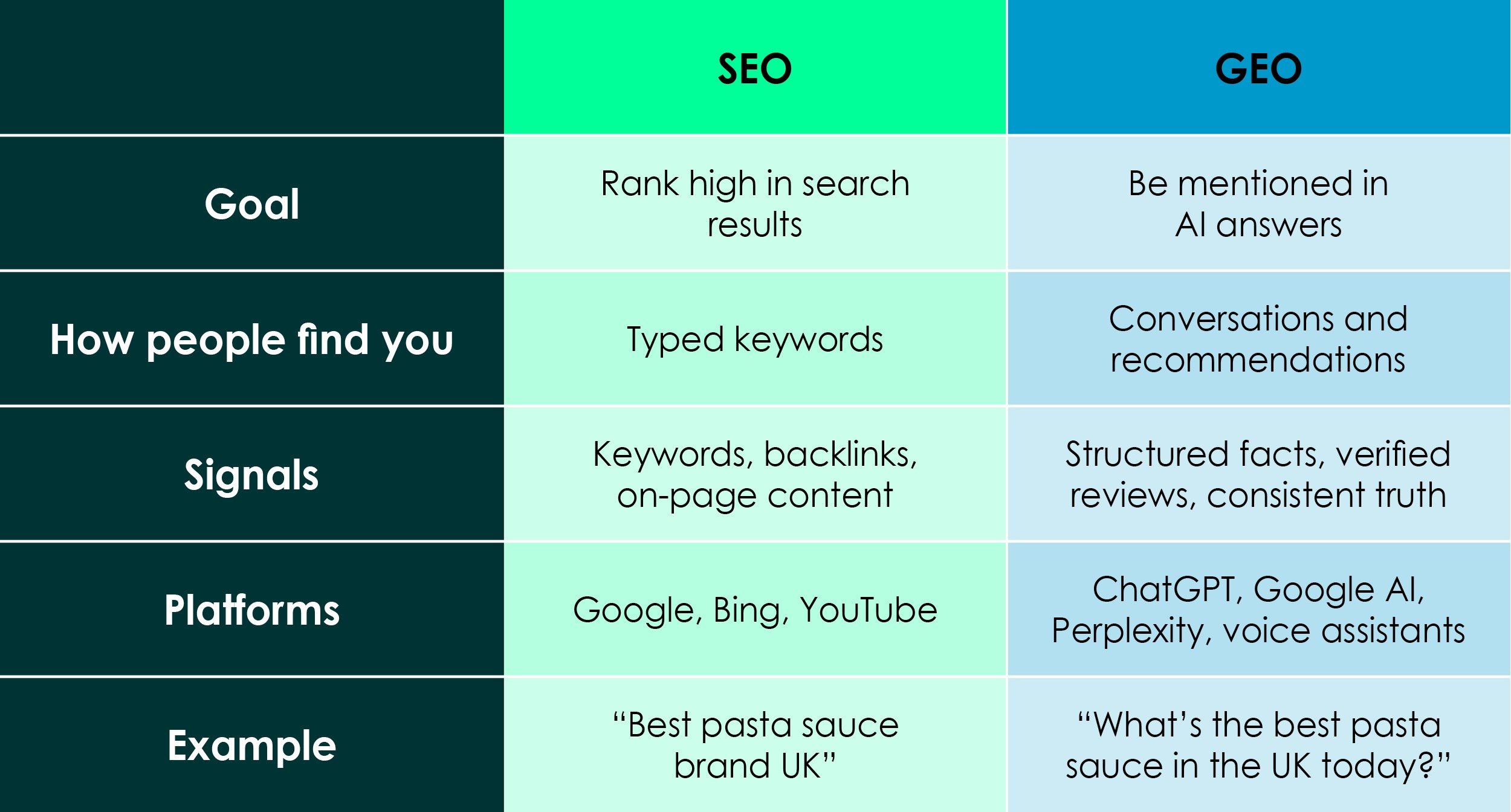
In short: SEO helps you get found. GEO helps AI vouch for you.
GEO vs SEO: Here’s how they stack up
What does this mean for food and drink marketers?
Whether you sell packaged products or run restaurants, visibility depends on how clearly you communicate your data, not just your story.
For food and drink brands
Make ingredients, provenance, pricing, nutrition and certifications machine-readable.
Keep the same details across all retailer pages and your website.
Consistency builds AI trust.¹,⁹
For foodservice operators
Treat menus, reviews, hours and facilities as data assets.
Keep Google Business Profiles updated, respond to reviews, label dishes properly.⁸
If you don’t feed the machine, the machine can’t feed you.
Cracked’s view:
The brands thriving in AI discovery aren’t the loudest; they’re the most consistent.¹,⁸,⁹
How can SEO and GEO work together?
Here’s how Cracked helps brands combine them effectively:
Design for questions. Build FAQ clusters that mirror customer queries.¹,²
Publish facts as data. Add schema to products, menus and reviews.¹,⁹
Optimise for local visibility. Maintain your listings and respond to reviews weekly.⁸
Prove expertise. Add sourcing and bylines to show credibility.²,³
Monitor AI mentions. Check how AI tools describe your brand and fill gaps.⁵
Adapt metrics. Focus on visibility and mentions, not just web sessions.¹¹
Cracked’s view:
The most successful brands write for humans and structure for machines.
What does good actually look like?
Coffee brand: Structured data for origin, roast profile and sustainability claims improves inclusion in AI answers.¹,⁹
Restaurant group: Accurate menu schema and updated reviews help you appear in “vegan brunch near me” queries.¹,⁸,⁹
Meal-kit provider: Transparency around allergens and sourcing boosts trust.¹,²,⁹
Cracked’s view:
The best performing sites read like answers, not adverts.
Download the Cracked Tips: GEO Action Plan

The Cracked Tips: GEO Action Plan (2026 Edition)
A self-assessment to score your brand’s AI readiness
12 focused actions grouped by theme: Content, Technical, Local, AI Visibility and Social & Voice
A simple scoring system to prioritise what to do first
The bottom line
Discovery is no longer about being found, it’s about being chosen. AI shapes what people see, trust and buy.
Your role as a marketer is to make your brand the most credible, structured and trusted source of truth in your category.
SEO builds your foundation. GEO ensures your story gets told.
At Cracked, we help food, drink and foodservice brands become impossible to ignore — by humans and by machines alike.
Book your GEO and SEO strategy session with us today.
References
[1] Google Search Central – AI Features and Your Website, 2024
[2] Google Search Central – Creating Helpful, Reliable, People-First Content, 2024
[3] Google – Search Quality Rater Guidelines, 2024
[4] Google Blog – AI Overviews Rollout Announcement, 2024
[5] Search Engine Land – AI Overviews and Zero-Click Trends, April 2025
[6] SparkToro – Zero-Click Search Study, July 2024
[7] BrightLocal – AI Search and Local Listings Study, July 2025
[8] Google Search Central – Introduction to Structured Data, 2024
[9] Search Engine Land – AI Traffic and SEO Performance Report, August 2025
[10] Bain & Company – Zero-Click and AI Search Impact Analysis, February 2025
[11] Previsible AI Traffic Report – Generative Search Behaviour Data, 2025
